
RURACTIVE emerging policy ideas on smart rural governance discussed at major rural and regional academic conferences in Porto and Gothenburg
As RURACTIVE is gearing to finalise its policy recommendations, a key part of this process is peer exchange with renowned academics, with two presentations at the Regional Studies Association and Rural Geographies annual conferences.
How can research-based knowledge become more relevant, legitimate and usable for rural policy? This question guided AEIDL’s contribution to the 4th European Rural Geographies Conference, held from 22 to 26 June 2026 at the University of Porto under the theme “Resilience, Innovation and Sustainability in a Changing World.”
During the RURACTIVE and FUTURAL joint session organised in the conference track “Digital Transition, Innovation and Rural Infrastructures”, Janne Sinerma and María Alonso-Roldán presented “Smart rural governance: barriers, drivers and enabling conditions”, sharing insights from both projects.
The presentation highlighted that rural innovation is not only about technological solutions. Experiences from the projects’ pilot territories (RURACTIVE Dynamos and FUTURAL Multi-Actor Pilots -MAPs-) show that successful transitions depend on governance conditions: cooperation between actors, capacity building, flexible funding mechanisms and stronger links between EU policies and territorial realities.
Insights from sister project FUTURAL, highlighted the value of applying place-based approaches, working with rural communities to co-create and test solutions responding to specific local challenges. Through RURACTIVE’s Rural Innovation Ecosystems (Dynamos) and FUTURAL’s MAPs, communities, public authorities, researchers and innovation actors collaborate to design and implement tailored responses. Across these exchanges with experiences from other projects, a common message emerged: rural communities should not be considered passive recipients of innovation, but active contributors to shaping their territories’ futures.
Discussing RURACTIVE proto-recommendations at Regional Studies Association annual conference
Just a few days earlier on 16 June, AEIDL’s senior policy expert Serafin Pazos-Vidal presented the proto-recommendations that will be discussed at the Fourth RURACTIVE Forum on 30 June 2026 at 9:30 – 11:30 CEST online, at the Regional Studies Association annual conference in Gothenburg, Sweden. This is one of the largest gatherings of academics, experts and practitioners on territorial development in Europe. Specifically, the RURACTIVE contribution took place at the seminar 'SS58. Cohesion Policy at a Crossroads: Evaluating Current Challenges and Shaping the Future MFF 2028-2034 II'. Organised by the Research Network on Cohesion policy, the contribution discussed De-territorialisation and Re-territorialisation of EU Cohesion Policies Post 2027. The notion of territorial development and how EU policies and EU funds will support smart and inclusive rural development is inevitably going to change once the National and Regional Partnership Plans (NRPP) are launched in 2028. Our emerging proto-policy recommendations were welcomed as pragmatic ways to address this new governance structure as to ensure that the NRPPs help tackle complex territorial development needs at a very local level, in lieu of being overlooked by centralised national plans.
The discussions in Porto and Gothenburg provided valuable expert feedback for the next steps of both projects, including the upcoming RURACTIVE Policy Recommendations and Guidance and FUTURAL’s future policy toolkit and recommendations, contributing to ongoing reflections on the future of EU rural policies.
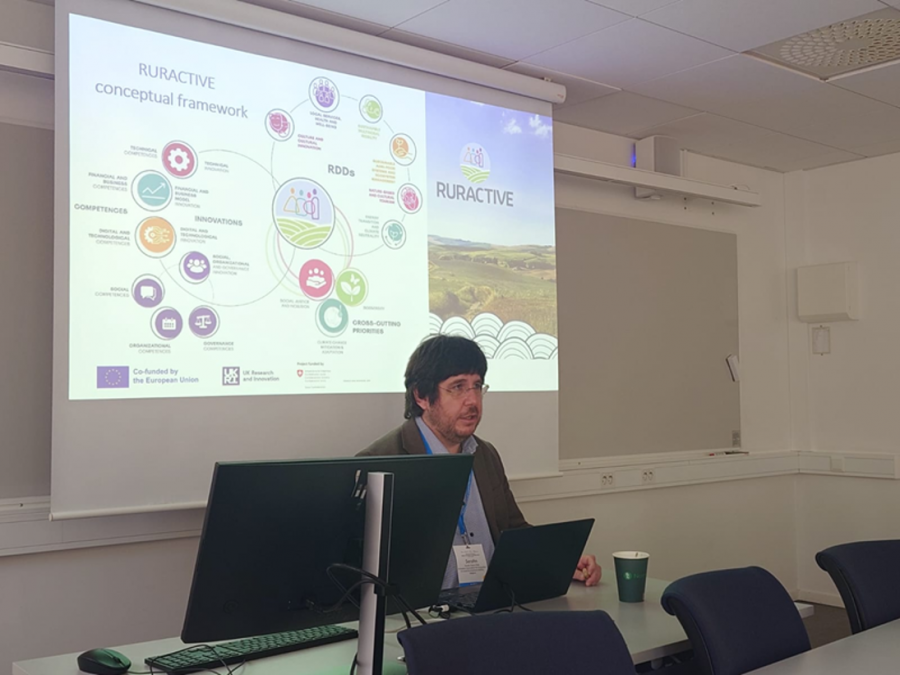 Serafin Pazos-Vidal at the Regional Studies Association in Gothenburg, Sweden
  Janne Sinerma and María Alonso-Roldán at the 4th European Rural Geographies Conference in Porto, Portugal